Meta Quest 3 vs Apple Vision Pro: which mixed reality headset should you choose?
· Michel Aguilera

We have already covered the subject of VR headsets a few times, for example in this article or also this one. Since then, new products have arrived on the market, such as the Meta Quest 3 or, more recently, the Apple Vision Pro, which marks Apple’s arrival in this sector. A quick overview of what has changed.
Is it real… or virtual?
One of the most significant changes is that today, products aimed at the general public offer 2 approaches: virtual reality and augmented reality.
Virtual reality (VR) and augmented reality (AR) are two technologies that make it possible to create immersive and interactive experiences. However, they differ in how they are used, depending on the degree of fusion between the real world and the virtual world.
Virtual reality
Virtual reality consists of immersing the user in an entirely virtual environment, generally using a headset or a similar device. The user loses contact with the real world and can interact with virtual elements, such as objects, characters or scenarios. Virtual reality is often used for entertainment applications, such as video games, films or simulations, but also for educational, professional or therapeutic applications, such as learning, training, design or the treatment of phobias.
Augmented reality
Augmented reality consists of superimposing virtual elements on the real world, generally using a smartphone, a tablet or special glasses. The user remains in contact with the real world and can interact with virtual elements, such as information, images or animations. Augmented reality is often used for communication, information or entertainment applications, such as social networks, navigation, tourism or games, but also for industrial, medical or artistic applications, such as maintenance, diagnosis or creation.
Differences in use
Virtual reality and augmented reality differ in use according to the degree of immersion, interaction and context. Virtual reality offers a higher degree of immersion, because it isolates the user from the real world and takes them into a virtual world. Augmented reality offers a higher degree of interaction, because it allows the user to manipulate virtual elements while remaining connected to the real world. Virtual reality requires a specific context, because it depends on the content and the device used. Augmented reality adapts to the context, because it uses the real world as its backdrop and can be used with different devices.

Mixed reality, which combines virtual reality and augmented reality, is a fast-growing field that offers many possibilities for immersion, entertainment and productivity. Among the most eagerly awaited headsets in this mixed approach are the Meta Quest 3 and the Apple Vision Pro from the Cupertino company. These two devices promise to revolutionise the user experience, but also have notable differences in terms of technical specifications, price and features. We are going to compare the main advantages and constraints of using these two mixed reality headsets.
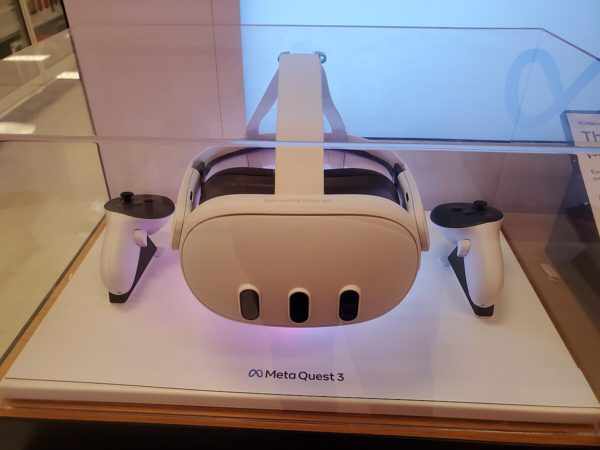
The Meta Quest 3 is the third generation of Meta’s (formerly Facebook) standalone virtual reality headset, succeeding the popular Oculus Quest 2. It has two LCD displays with a resolution of 2064 x 2208 pixels per eye, i.e. a pixel density of 1,218 ppi. It is equipped with a Qualcomm Snapdragon XR2 Gen 2 processor, 8 GB of RAM and 128 GB or 512 GB of internal storage. It also offers hand tracking (but no eye tracking), two colour cameras for mixed reality and a spatial audio system. It runs on Meta’s operating system, which provides access to a large catalogue of virtual reality games and applications, as well as social experiences such as Horizon Worlds. The Meta Quest 3 is sold at 549 euros for the 128 GB version and 699 euros for the 512 GB version.
Now let’s talk about Apple.
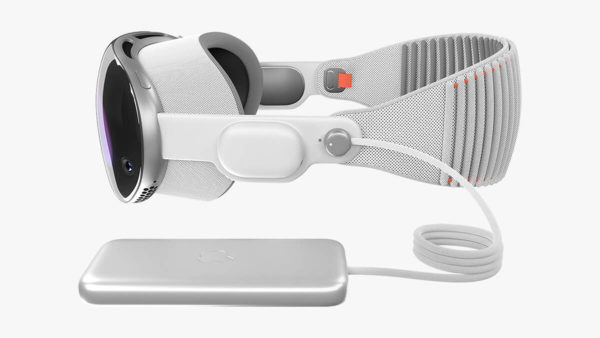
The Apple Vision Pro is the first mixed reality headset from the apple brand, announced in June 2023 and available in the United States since 2 February 2024. It is a hybrid headset that lets you adjust the level of immersion between augmented reality and virtual reality using the Digital Crown. It has two micro-OLED displays totalling 23 million pixels, more than a 4K TV for each eye. It is powered by an Apple M2 chip, assisted by the new R1 chip dedicated to processing the sensors, with 16 GB of unified memory and 256 GB, 512 GB or 1 TB of internal storage. It also incorporates eye, face and hand tracking sensors, as well as a spatial audio system. It runs on the visionOS operating system, which provides access to an ecosystem of mixed reality applications and services, such as Apple Arcade, Apple Music or Apple TV+. The Apple Vision Pro is sold from 3,499 dollars in the United States (256 GB version).
Let’s review the advantages and constraints of the 2 devices.
The Meta Quest 3 and the Apple Vision Pro have advantages and constraints of use that depend on their technical specifications, their prices and their features. Here is a summary of the main points to take into account when choosing between these two mixed reality headsets:
- The Meta Quest 3 and the Apple Vision Pro offer comparable battery life: about 2.2 hours on average for the Meta Quest 3 (built-in battery), compared with up to 2 hours of use (2.5 hours of video) for the Apple Vision Pro with its external battery.
- The Apple Vision Pro offers better image quality, with a higher resolution and pixel density than the Meta Quest 3, which translates into greater sharpness and better colour rendering.
- The Meta Quest 3 benefits from a far more affordable price, about seven times lower than that of the Apple Vision Pro (499 dollars versus 3,499 dollars in the United States), which makes it more accessible to the general public.
- The Apple Vision Pro offers great versatility, with the ability to move gradually from augmented reality to virtual reality, which lets you enjoy different types of experiences and interact with the real environment.
- The Meta Quest 3 has a richer catalogue of virtual reality games, while the Apple Vision Pro launches with more than 600 apps designed for it (plus more than a million compatible iPhone and iPad apps), which gives gamers more choice and variety on Meta’s headset.
- In terms of connectivity, the Apple Vision Pro supports Wi-Fi 6 and Bluetooth 5.3, compared with Wi-Fi 6E and Bluetooth 5.2 for the Meta Quest 3; its real strength is its integration with other Apple devices, for better communication and synchronisation.
A look at the various differences:
In short… will we project ourselves into the real… or the virtual?
The Meta Quest 3 and the Apple Vision Pro are two mixed reality headsets that offer immersive and innovative experiences, but they stand apart in their technical specifications, their prices and their features. The Meta Quest 3 is better suited to users looking for a standalone virtual reality headset that is powerful, affordable and comes with a large catalogue of games and applications. The Apple Vision Pro is better suited to users looking for a hybrid, high-end, versatile mixed reality headset integrated into the Apple ecosystem. The choice between these two headsets therefore depends on each person’s needs, preferences and budget.