IT & AIInfrastructure & networking
Internet: access from the sky with StarLink
· Michel Aguilera

With 4G or 5G internet links, over fibre or copper, we are all able to enjoy internet access, with ever better speed and stability. For those who are nevertheless isolated, there is now an option: satellite internet access. We are going to talk about StarLink, one of Elon Musk’s companies. Discovering internet by satellite.
Internet… from the stars!
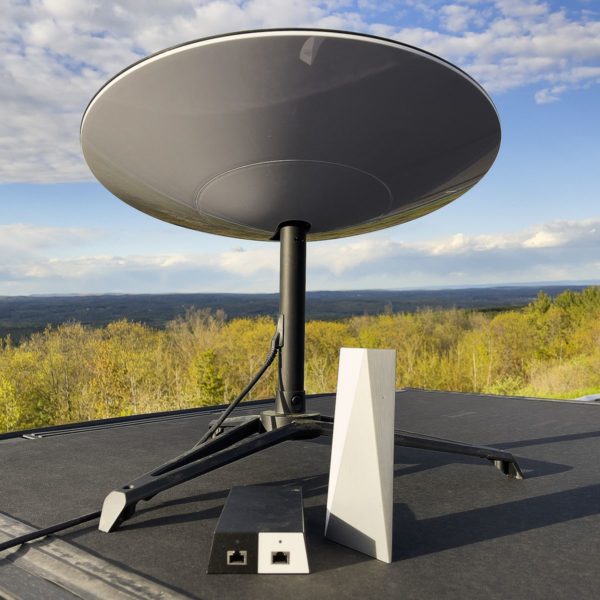
The project officially started in 2015 but could only go ahead after the launch of the first satellites in 2019, using Falcon-9 launchers. At that time, the idea was to provide the widest possible coverage from the sky, with fairly simple equipment that could be quickly connected at users’ homes, provided they had access to a sufficient area. These launches were organised by SpaceX, Elon Musk’s company. The goal is also to tie StarLink’s revenue to a project to colonise Mars, with the establishment of a city on the red planet.

According to Elon Musk, this project is part of a vast technology programme that will be exploited to enable a great leap forward in communication systems, everywhere on Earth but also in space. Interesting fact: all the satellites run on Linux! Thanks to a modified version of the OS, the thousands of computers are interconnected and synchronised with each other to operate the satellites in real time. SpaceX has in fact built its own version of Linux, to adapt the OS to all the components and specificities of its spacecraft. It is also thanks to Linux that the satellites deploy their anti-collision mechanisms, using artificial intelligence.
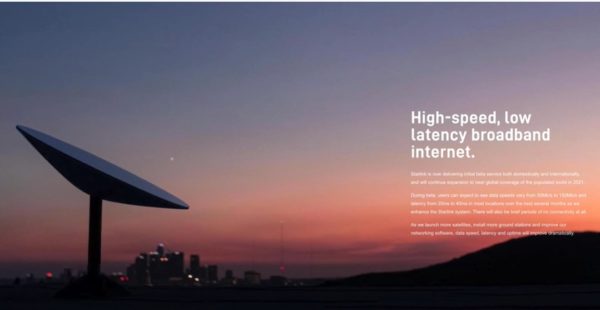
For those who are curious to know how the satellites are distributed in orbit around the Earth, I invite you to visit this site. And if you want to see what SpaceX satellite launches look like, a Youtube channel has been created for that: you can click on this link. This space adventure will make it possible to access the internet from practically anywhere on the globe. We recently received the starter package, which we unboxed and installed in this video:
As you can see, you need the StarLink app, available on iOS or Android. The Starlink app provides advice on how to install the Starlink satellite dish, as well as the connection status (including signal quality), a device overview to see what is connected to your network, and a speed test tool.
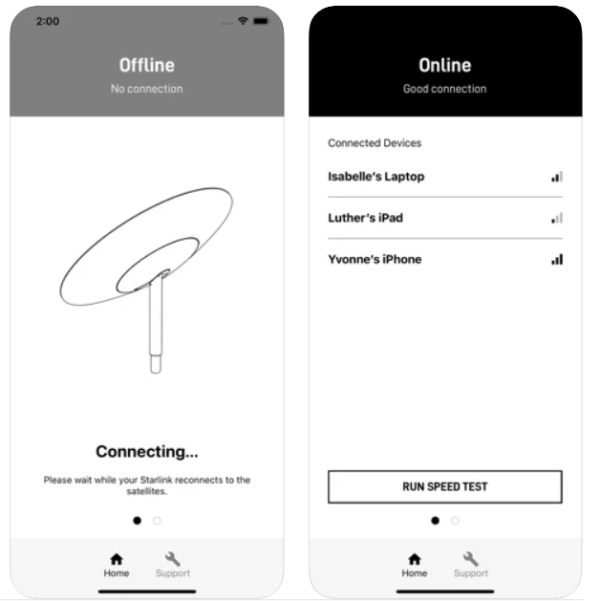
It is similar to other mobile apps for managing home Wi-Fi connections and routers. In terms of price, StarLink states that the cost for participants in this programme will be $99 per month, plus an initial one-off cost of $499 to pay for the hardware, which includes the mounting kit and the receiver (antenna and connection hardware), with WiFi networking capabilities. The long-term goal is to offer reliable, low-latency broadband that provides a consistent connection by handing off connectivity between a large constellation of small satellites circling the globe in low Earth orbit. SpaceX has launched nearly 12,000 of them, but hopes to launch several thousand more before achieving global coverage and offering general availability of its services. The initial calibration, depending on the location of the antenna and any visible obstacles, may restrict the quality of the satellite signal.
In short, are we connected?
Setting up the system (although greatly simplified) is not yet within everyone’s reach. The challenge remains to see whether the coverage (and the gigabit bandwidth promised before the end of 2021) will be achievable. The fact remains that being able to imagine quality internet access everywhere is becoming conceivable. There are nevertheless still a few problems:
First of all, there is the problem of space debris. SpaceX’s first batch of Starlink satellites contained at least 5% “dead” or unresponsive units which, according to the company, were to deorbit naturally and burn up in the atmosphere. Once thousands of these satellites have reached a higher orbit, it is reasonable to assume that a certain number of them will malfunction. At that point, the descent will take much longer (five years at an altitude of 340 miles and even longer at higher altitudes), and until they come down, they will pose a threat to other satellites and space installations. Even though SpaceX says the satellites have an automated collision avoidance system, there is a good chance that it will not work at all in a number of “dead” satellites, turning them into passive debris capable of destroying other satellites and endangering space. Secondly, it is possible that Starlink satellites will obstruct observational astronomy. As they glow brightly in the night sky, reflecting light towards various lenses and cameras, they could make ground-based astronomy impossible once tens of thousands of them have been launched. SpaceX is already working on this with an experimental darkening treatment that will be applied to a test satellite to see if the glare from its body can be reduced. If successful, the coating will also be applied to the next batches of satellites.
These problems are far from easy to solve and should be addressed as soon as possible. We bet the SpaceX teams will manage it quickly.