Smart devices & lifestyleSmart home
Smart speakers, or the new virtual presence
· Michel Aguilera

Smart speakers have been appearing in shops for some time now. But what more can they actually offer? Are they just an intrusive gadget? Can this new way of delivering audio help with everyday tasks, or is it simply the ultimate means of spying on users even more effectively? We are going to give an overview of the subject and share our analysis with you. Decoding a newcomer to the… connected home!
I’m listening to you… And you talk back!
To get an idea of what connected audio products are, you need to know concretely what we are talking about. In practice, it is a wireless speaker that lets us listen to music… But not only that!
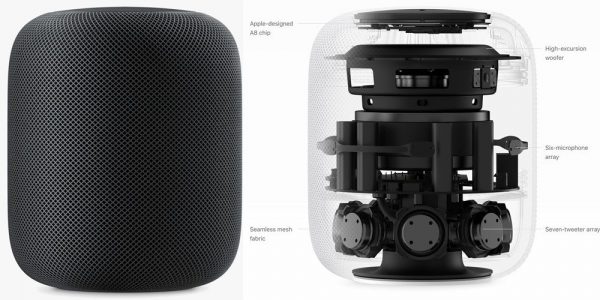
Fitted with microphones, these speakers are connected to a voice assistant (depending on the manufacturer, you may have a choice). Apple has announced its HomePod, a product due out in the first quarter of 2018. Here is a short video review of the product by a YouTuber from Quebec:
The product promises top-notch music quality, and we will write a dedicated article as soon as it comes out! As mentioned in the video, it will be linked to Siri, Apple’s voice assistant. Home integrations will be done with manufacturers that have adopted HomeKit, Apple’s certification and compatibility programme.
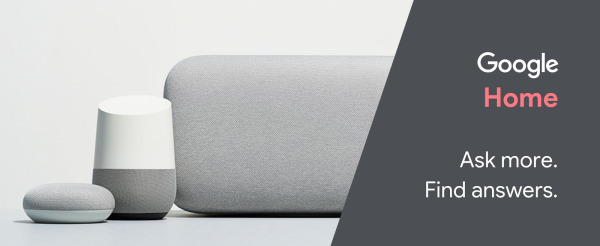
The competition has got itself organised and is ahead of Apple. Google and Amazon have both developed the smart speaker concept, each with its own specific ranges of products and services. It is also possible to connect to third-party services such as Spotify, Deezer or Netflix.
Google Assistant comes paired with Google Home (standard, Max and Mini versions) to offer users an experience tied to the famous search engine. Let’s watch an explanatory video in French about the standard Google Home:
As you will have gathered, the big advantage is not only being able to ask the speaker to play music, but also to have it act as a go-between with all the other connected devices in the home! The Max model of Google Home is available in the US for $399.
JBL
Having also been able to test a speaker of this type, we find its sound quality clearly superior to that of the Google Home. Other manufacturers are hard at work and will soon announce their own products. One launch that made quite a splash is Sonos with its One (which can integrate several AI voice assistants).
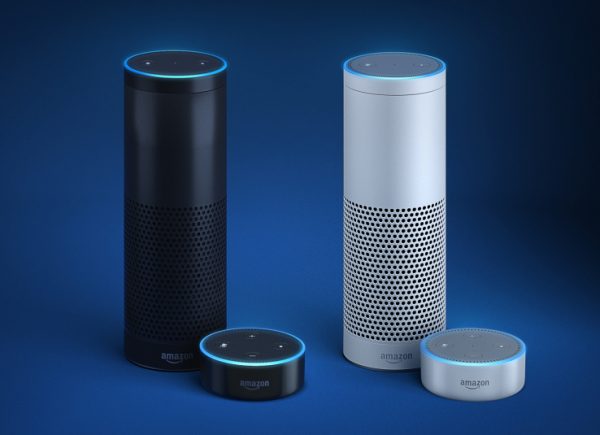
We cannot overlook Amazon Alexa. One of the first players in the smart speaker field, it also offers more integration with third-party services than its competitors.
A little fight in English, Amazon versus Google:
The only drawback of Alexa: it only works in English! This may be a problem for some non-English-speaking users. So using it in French is out (at least at the time of writing this article).
For those tempted by Google Home or by products that integrate Google’s voice assistant, you should know that it has a fairly substantial list when it comes to integration with connected devices in the home.
But what happens if you cannot find your amplifier or your home automation hub in the list? Well, if your devices can integrate IFTTT, you can build bridges between them and control everything by voice! Here is a short demo of an integration between Google Home, IFTTT and a Logitech Harmony Hub:
Besides this integration via IFTTT, we were also able to interface with a Myfox home automation system, for the security system and for controlling the electric blinds. A resounding success!
In short, should you let yourself be listened to?
We have talked about technology and demos. But one question remains that many users ask themselves: when we are not talking to these speakers, are they listening to us? According to Google, only the wake commands trigger listening. So why add a Mute button? In other words, when you use the voice assistant, a trace remains recorded in your Google profile (which you can view online at any time). The company therefore keeps recordings such as “OK Google, wake me up at 7 am” or “Hi darling, I’m on my way, I’ll buy the bread”. But in no case the intimate conversations you have near your speaker. At least, nothing proves it does. And recording and then permanently transferring audio recordings would certainly have been spotted by security researchers. For what purpose? Once again, Google claims it is to refine voice and command recognition. The same story from Apple with Siri, Microsoft with Cortana, and Amazon with Alexa. We can bet that we will see other situations regarding the real use of the commands we give these speakers. Good network protection for your home (a full firewall) remains a necessity, all the more so with connected devices communicating within your environment.